Flaws and All
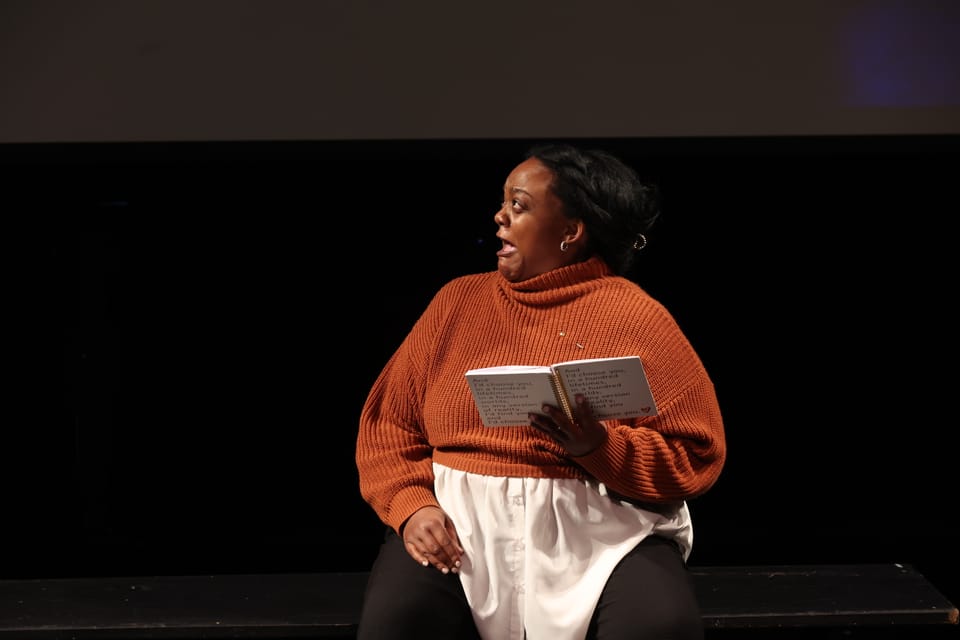
Three drafts, many rounds of edits, and more tears than I could count, and I found myself sitting with a script for my solo show playwriting class. The rewrites were relentless.
You scrutinize every word, only to find yourself debating the simplest lines in class. Should the character say, “Am I broken?” or “So, I’m broken?”? They look nearly identical on paper, but on stage—spoken, embodied, lived—the power of a single word matters. As a writer, you feel the necessity of nailing the moment’s emotion, knowing that each line breathes life into the world you’re creating.
Playwriting was a completely different creative process for me, one I had to be carefully coached through. Over multiple drafts, the same problem emerged: I ended each scene with a solution, leaving my characters no room to grow. I was tidying up the mess before they had even learned the lesson.
“I love the direction, but why would I, as an audience member, stay until the end if you’ve solved the problems in Act One? Does life work that way?”
That feedback stuck. Because no, life does not work that way. Yet, in this play, I was trying to do what none of us can—fix everything, wrap up all the loose ends, make my characters neatly manage their emotions in a single act. Is that too much to ask for? This is very ironic, considering it took me over thirty years to tell this part of my own story because I wasn’t ready to face what would come from saying the big, scary things out loud. Nothing—not even a life built for the stage—gets resolved in five pages.
So, I went back to the keyboard. I unraveled the solutions. I let my characters struggle, learn, and exist in the uncertainty—closer to what had happened in my real life. I could almost see them side-eyeing me, saying, “We had it together, and now here you come with your extended lessons. Damn you, keyboard lady!”
When I started writing, maybe some of me believed that a semiautobiographical play would help me fix the parts of my story that I still struggled to accept. But telling this story—on paper and then on stage—required the same intentional, exhausting work I had to do in real life. Of course, even a fictionalized version of me needed that process.
The script is written and taken to the stage, to be experienced in front of an audience. The characters exist in the real world, so guess what? People related to the characters because the human experience is rarely straightforward for any of us or without a depth of unmanaged emotions. I learned that people could hold the messiness just fine from the stage, and likely just as well off.
It's time to begin considering my characters' (and my) next act, and I must do what I failed to do in those first drafts: leave space for evolution. Let the characters move beyond the final act, making new mistakes and learning new lessons. Because I am not here to fix them. I am just the person giving them the space to exist. Through this continued writing process, I hope to learn to extend that same grace to the nonstage version of me, you don't need to be solved, you need to evolve.
Evolution here we come.
Comments ()